Showing posts with label foal. Show all posts

Thursday, October 27, 2011

Open Letter to BLM, Egan NV Field Office re: Proposed Pancake HMA Roundup

----- Original Message -----
Sent: Thursday, October 27, 2011 6:19 AM
Subject: Pancake Complex Gather


BLM Ely District Office
HC 33 Box 33500
Ely, NV 89301

Attn: Gary W. Medlyn, Egan Field Manager

Dear Mr. Medlyn, et al;


I am a native and third-generation resident of rural White Pine County, Nevada. I am descended from ranchers, miners, and the original "mustangers". My family includes hunters and outdoorsmen - all of whom consider our freedom to enjoy access to public lands as bordering on the sacred. As a nature photographer, my life and livelihood are vested in the land of my forefathers. Wild horses are an integral part of my pioneer heritage.

I have followed various bands of wild horses continuously over the past decade. Initially, I believed all that I had been told about wild horse and burro management. I accepted the "fact" that it was necessary to gather mustangs periodically for their own welfare, as well as for the health of the range. I did - and still do - appreciate the concerns of stockmen endeavoring to make an honest living on the land. (Not to be confused with those making their fortune from government-sponsored subsidies.)


Over the course of long-term observation, I began to notice that at least some of what I had believed about mustangs was not accurate. After several years, I came to know that there was a great deal of misinformation about wild horses, and their natural habitat in the high desert terrain of central eastern Nevada.


Reluctantly, I decided to observe a BLM "gather". My first experience was at Conger, Utah. This was an "in-house" all-BLM operation. What I witnessed was a well-organized, orderly operation. I went home believing that the helicopter-driven roundup process was marginally humane. 

During the winter of 2010-11, I had the opportunity to observe at Nevada's Antelope Complex, and this past summer, in Triple B HMA's.  These gathers completely and permanently altered my perception of standard helicopter round-ups. 


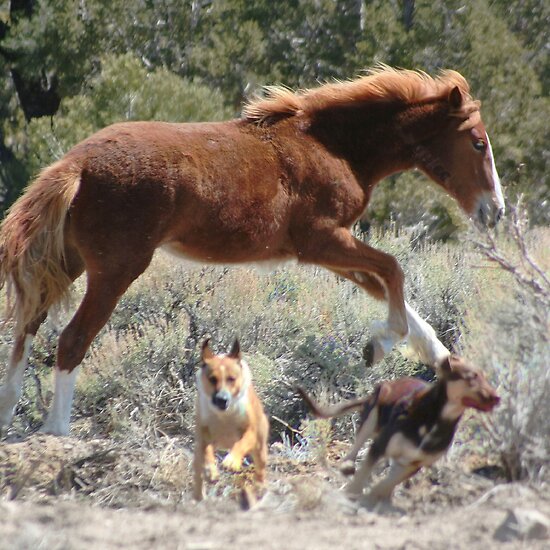
Again and again, I watched as Sun J pilot, Josh Helyer, flaunted his obvious contempt for the horses he was charged with shepherding into captivity. I observed (and photographed) this pilot over-driving and over-running horses and foals. I saw young foals driven many miles over extremely rugged terrain. I saw very old, non-reproducing horses driven to the breaking point. I saw family bands deliberately scattered. I witnessed close encounters in violation of BLM guidelines, and the laws of the State of Nevada. (These photos are available for your review, upon request.)  I know of at least two domestic horses that died as a direct result of Mr. Helyer's radical style, in Steptoe Valley.


No other animal - wild or domestic - is herded by helicopter.  The standard horse racetrack is one-quarter mile, and only horses over the age of two years are permitted to participate in these races. There are reasons for that, based upon well-founded knowledge of equine anatomy.


Furthermore, I have been utterly dismayed by the blatant misrepresentation of true conditions of the range.  For example, visiting advocates at the Butte Valley operation in August, were told that BLM had been hauling water into the area for four months.  2011 has been one of the wettest years on record. I am continually out on this range, and have documented the abundance of water throughout the year, and in years past. If someone is being paid to deliver water here, there is flagrant misappropriation of funds. Nowhere in this region have I seen ANY need for supplemental water, as perennial water sources have remained at optimum levels throughout the summer. Neither is there any shortage of forage; and there has not been, since the drought ended, years ago.


I have been shocked and appalled to learn that this district plans to geld and release 200 stallions in the Pancakes HMA.  An identical proposal was scrapped in Wyoming this past summer because it was proven to be without any merit, whatsoever.  Gelding is the most preposterous excuse for "population control" ever devised. Whomever came up with this scheme clearly has no knowledge of wild horse social structure, or natural selection. Gelding will have NO EFFECT on population growth. 


Releasing 200 non-reproducing males will create tremendous confusion in herd counts.  Implementation of this sadistic and pointless EXPERIMENT would reflect negatively on the state of Nevada. There is no plan in place to accurately monitor the "success" of this EXPERIMENT.


I deeply object to the rationalization that horse trails are detrimental to the "wilderness experience". Gentlemen!  Mustangs are an integral part of the wilderness experience. Visitors to our state are, in my opinion, as interested in seeing wild horses, as any other wildlife. It seems to me that Nevada has the last remaining truly wild horse population, as herds in other states have become socialized, and accustomed to public contact. Our wild ones can be an economic boon to tourism, given half a chance.


Existing Wild Horse and Burro Programs are in desperate need of reform! 


I support the development of volunteer programs that enlist the input of public observers in documentation of herds and range conditions. Put my name at the top of that list! When real hands-on management of herds at the local level is implemented, large-scale removal will not be necessary. The technology exists to monitor and control wild horse populations without massive roundups.


We need to: 
  • Stop stockpiling non-adoptable horses in exorbitantly expensive long-term holding facilities at the burden of taxpayers.
  • End cruel and inhumane helicopter roundups. There are better methods available.
  • Implement programs that utilize public observation and regional knowledge of wild horses, and the range they inhabit.
  • Foster public awareness in support of healthy herds based on TRUE and accurate information.

Thursday, July 21, 2011

(2011.JUL.20) Day One - Triple B Gather

(2011.JUL.20)


In our role as advocates for better treatment of our wild herds, it often seems like only the mistakes and abuses are talked about. The worst aspects of wild horse management operations do need to be brought to light, AND we should be just as quick to recognize improvements as they occur. 


Today, it must be said that Sun J and BLM did an excellent job in all aspects of their gather operations, and every part of the process was carried out with professionalism and skill.

Sun J pilot, Josh Hellyer, showed marked improvement from his earlier
performances at the Antelope Complex gather, early this past winter.
Throughout the day, Josh held back from the running herds, and at one point, even fell back and allowed them to rest and regroup before continuing into the jute enclosure.

None of the horses entering the trap appeared unduly stressed, and no lather appeared.

We noticed that most of the overhead railings were padded. Our BLM rep explained that the padding had been suggested as a way to reduce neck and head injuries, this small improvement has been incorporated into the standard setup. (One example of how speaking quietly gets better results than screaming epithets.) 
Padded overhead rails are known to reduce injuries significantly.

 A few of the railings were missing pads, and this was also pointed out to the rep.


Situated in a gravel pit, the gravel mounds provided an excellent point of vantage for wranglers.


Today's trap set-up was unique, inthat the trap and sorting corrals were directly connected to short term holding pens. This eliminates one in a series of loading and unloading, as the horses will be taken directly to their destination in Gunnison, UT.  This not only reduces stress on the horses, it is economically advantageous.


The pens were well supplied with fresh water and hay. A water truck from BLM Fire filled troughs, and then encircled the pens with a swath of cooling spray to quell the dust. We noticed that the animals seemed undisturbed by the large truck driving around the pens, while workers on foot were frightening to them. Given that this is a mining area, the horses are used to heavy vehicles rolling through their habitat.


The sorting process was carried out quickly and efficiently, and each group of animals settled down quickly after sorting.
The four-wave gather brought in eight stallions, eight dry mares, two mares with foals, and two heavily pregnant mares, for a total of twenty-two. At the end of the day's gather operations, we were invited to approach the holding pens.  All animals were in very good condition, and no series injuries were observed.
It is gratifying to note that cooperative efforts between advocates and BLM have brought about some improvements in the roundup process. We can be grateful for the horses' sakes. Such progress in dialogue bodes well for continuing efforts to achieve a healthy equine environment, and an end to mass removals of horses from their native ranges.

This is no time to relax our efforts toward achieving transparency  in all phases of wild horse management.


Please support GrassRootsHorse.com


Wednesday, February 23, 2011

The Miracle Of Spring: Orphan Mustang

2009.JUN.19 —

Yesterday afternoon, my friend, Glenys, and I set out to test my new lens.


We were going to go south, to a certain place where we thought there might be deer or elk grazing. As we came up to the turn-off, I said, “What about going to the spring below Becky Peak, instead?” (There are usually some wild horses around there.) She was all for it, so instead of turning right, we went straight, then cut across the main highway and drove north along the parallel seldom-traveled old highway.

At the spring, we were disappointed to see no recent sign of horses, so we amused ourselves with wildflower macro, instead. I walked up around the oasis to try for afternoon backlight. My friend went the other direction, so the spring and all its vegetation was now between us.

Suddenly, I heard a horse nicker and snort. Then, I heard Glenys exclaiming and urging me to come quickly. I feared she was face-to-face with a mad stallion. As I made my way around the waterhole and through some high brush, I stepped out in the clearing to see her standing about 50 feet from a mustang colt. They were having a conversation, but the baby was not letting her get close to it …...


Spring: Day One (2009.JUN.18)

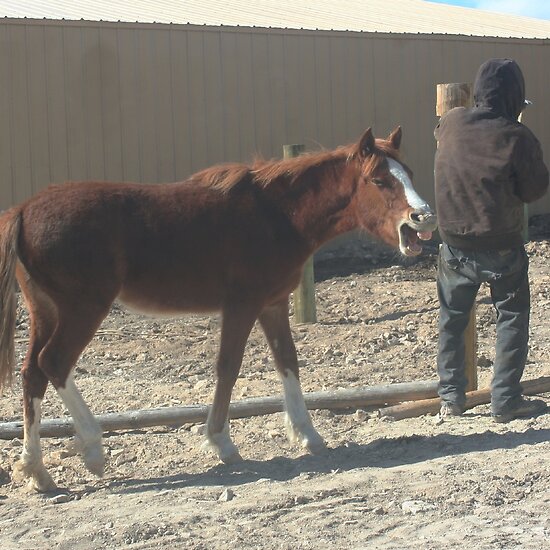
We soon realized that the foal was abandoned and starving. It had multiple injuries, apparently the results of a cougar attack. Miracle of marvels: The tiny foal – just a few days old – had somehow survived … but she was so severely injured, the herd had left her for Nature to finish the job. Such is the way of the wilderness.


Spring: Day One (2009.JUN.18)


There was little discussion on the matter; as the little one went off down the hillside, we got back into my pickup and headed straight for home, and to the one person we knew would do something to help this poor baby: our neighbor, Ray. A horse whisperer, of sorts, Ray already has one mustang orphan, and his success with her has been phenomenal. When I told him about the orphan, he replied without hesitation, “Let’s go get it!”

It took us a couple of hours to make all the preparations hitching up a horse trailer, finding some tack, then getting all the way back over to the spring. I was afraid we would be too late. The sun was sinking. My shooting buddy, who is still recovering from recent surgery, had become exhausted by the day’s events, and reluctantly decided not to go back with us, so it would just be Ray and me, on this mission of mercy. She said to me quietly, “Tell Ray it’s name is Spring.”


Before we got to the location, we spotted the foal above us on the hillside. A herd of wild horses was approaching, but quickly did an about-face when they saw us. Little Bit continued munching on grass, not really paying much heed to the two of us, as we slowly approached her.

She didn’t run, but bolted and trotted a short distance each time we got too close. Ray started trying to lasso her, cowboy style – but the rope was too soft, and would not make a loop wide enough to encircle the horse’s head. Success finally came when I caught the colt’s attention by talking to it, while Ray reached out and grabbed her by her fuzzy little tail. He held her from behind, while I slipped the rope around her neck.

She didn’t like being restrained, but Ray is very wise in the ways of horses, and he allowed her to “lead us” – him on one side, I on the other, just behind her withers.

Soon, we were back to the truck, and ready to try and load her into the trailer. He had tossed in a flake of hay, and she was so hungry, she went most of the way in, then balked. He got her front half tethered inside, while I pushed from behind.

Success!

Little girl was so hungry, she went for the hay, and drank a bit of water that I brought over from the spring. When she was calm, we drove back to Cherry Creek. I’m sure it was a frightening experience for the horse, but there was no other way.

The sun had set, and as we drove away from the watering hole, I heard the howling of many coyotes nearby. I know that had we not done what we did, when we did it, the little one would not have lived to see the sunrise. Those predators would have taken her down.

Ray dressed her wounds, and we put a couple of horse blankets on the floor of the trailer for Spring to lie on. That was all we could do for the day. She would spend the night there, safe and snug. In the morning, he would go to town for milk supplements and pennicilin, and then make a stop at the local BLM office to start the paperwork on Spring’s adoption. There will be no complications with the bureaucracy; he is already on their list for mustang orphan adoption …...

I don’t believe in “random luck”. I find nothing “accidental” in the impulsive decision that lead my friend and me to turn north, instead of south, at the precise time that we did.

Spring had survived a vicious mountain lion attack, and would undoubtedly have perished by the violence of coyotes, or starvation, had we not come to the place we did, at exactly the time that we did.

Somebody has big plans for little Spring. I am blessed to have had a part in her rescue!  (I only regret there are no photographs of the rescue process. I kind of had my hands full with horse-wrangling. ;D)


Spring: Day Ten (2009.JUN.28)


Spring: Day Twenty (2009.JUL.08)

Spring’s RedBubble Album:
The Miracle Of Spring

Five Weeks Later


UPDATE: Eleven Weeks


Mustang Milestone: The Freeze Brand

(2009.AUG.17)


UPDATE: Twenty Weeks


UPDATE: Spring’s First Taste Of Winter

(2009.DEC.13 – Six Months)


UPDATE: ‘Helping Papa Ray’


(2010.MAR.22 – Nine Months)


UPDATE: Scramble!

(2010.APR.07)


(2010.JUN.20)


Please support the
American Wild Horse Preservation Campaign