
Saturday, November 26, 2011


Saturday, October 29, 2011
The Triumphant Return Of Blaze
(2011.OCT.29) -
The story of Blaze is the stuff local legend.
In August, the BLM arrived in this peaceful valley, intent upon removing ALL of the wild horses living here.
Blaze, a three-year old bachelor, was photographed running behind a string of mares and foals destined for the trap.
Later, I heard that a stallion had escaped from that trap – and that a palomino foal had tried to follow suit. The stallion got away, but the foal was killed after her injuries from the barbed wire were deemed too serious for treatment.
When I went back to survey the area days later, I saw a family of nine horses. A rancher told me that the band had sneaked off into a canyon while the helicopter was chasing the escaped stallion, and that after the trucks left with their haul (25 mustangs), the stud had gone back to reunite with his family in hiding.
Although I was glad to find this band alive and well on their home turf, there was sad disappointment when I discovered that the stallion was not Blaze, but his old sire.
Advocates that went to Gunnison prison told me that no horse fitting Blaze’s description had ever come in. I did not dare to hope. I wondered what had become of my friend. Had he been an undocumented casualty of the stampede?
On a recent jaunt through the valley that this herd calls home, I noticed two mustangs off in the distance. I thought they must be young stallions driven off from the “Cherry Creek Nine” - now, the only remaining wild band in this valley. They were too far away to get a clear shot, and I had people with me, so I went on my way without trying to get in closer.
I returned the next day alone. The two horses were a little closer to the road, and I was able to approach them, a BIT. When I got close enough, they bolted and headed for the trees. My heart was leaping, for I was almost certain that the lead stallion was my friend, Blaze. Couldn’t wait to get home and magnify my images … and what I found there, was confirmation that one of my wildest dreams had come true: Blaze was home!
Putting all the pieces together, I realize that the old stallion with the Cherry Creek Nine had never been in the clutches of the BLM’s machine, but had remained with his mares the whole time. The valiant escapee had, indeed, been Blaze.
The story of Blaze is the stuff local legend.
 |
| (2011.OCT.28) The Triumphant Return Of Blaze - and Co. |
In August, the BLM arrived in this peaceful valley, intent upon removing ALL of the wild horses living here.
 |
| Blaze - taken a few days before the round-up. I feared it would be the last image I would ever get. |
Later, I heard that a stallion had escaped from that trap – and that a palomino foal had tried to follow suit. The stallion got away, but the foal was killed after her injuries from the barbed wire were deemed too serious for treatment.
When I went back to survey the area days later, I saw a family of nine horses. A rancher told me that the band had sneaked off into a canyon while the helicopter was chasing the escaped stallion, and that after the trucks left with their haul (25 mustangs), the stud had gone back to reunite with his family in hiding.
Although I was glad to find this band alive and well on their home turf, there was sad disappointment when I discovered that the stallion was not Blaze, but his old sire.
Advocates that went to Gunnison prison told me that no horse fitting Blaze’s description had ever come in. I did not dare to hope. I wondered what had become of my friend. Had he been an undocumented casualty of the stampede?
 |
| 2011.OCT.28 - Blaze & Friend |
I returned the next day alone. The two horses were a little closer to the road, and I was able to approach them, a BIT. When I got close enough, they bolted and headed for the trees. My heart was leaping, for I was almost certain that the lead stallion was my friend, Blaze. Couldn’t wait to get home and magnify my images … and what I found there, was confirmation that one of my wildest dreams had come true: Blaze was home!
Putting all the pieces together, I realize that the old stallion with the Cherry Creek Nine had never been in the clutches of the BLM’s machine, but had remained with his mares the whole time. The valiant escapee had, indeed, been Blaze.
I don’t know where he has been, these past two lonely months, but I am over the moon to see him again, back where he belongs. Happier still, that he has a companion, now. I am not yet 100% sure that’s a mare by his side, but OoooH! Is he ever protective of his beautiful young friend!
 |
| The reason for the name: Blaze |
 |
| The first time I saw Blaze alone. |
 |
| Blaze's first family: The Cherry Creek Band (stallion not shown) -- 2011.OCT.27 |
Wasted Sorrow
Thursday, October 27, 2011
Open Letter to BLM, Egan NV Field Office re: Proposed Pancake HMA Roundup
----- Original Message -----
From: Arla M. Ruggles
Sent: Thursday, October 27, 2011 6:19 AM
Subject: Pancake Complex Gather
BLM Ely District Office
HC 33 Box 33500
Ely, NV 89301
Attn: Gary W. Medlyn, Egan Field Manager
Dear Mr. Medlyn, et al;
I am a native and third-generation resident of rural White Pine County, Nevada. I am descended from ranchers, miners, and the original "mustangers". My family includes hunters and outdoorsmen - all of whom consider our freedom to enjoy access to public lands as bordering on the sacred. As a nature photographer, my life and livelihood are vested in the land of my forefathers. Wild horses are an integral part of my pioneer heritage.
I have followed various bands of wild horses continuously over the past decade. Initially, I believed all that I had been told about wild horse and burro management. I accepted the "fact" that it was necessary to gather mustangs periodically for their own welfare, as well as for the health of the range. I did - and still do - appreciate the concerns of stockmen endeavoring to make an honest living on the land. (Not to be confused with those making their fortune from government-sponsored subsidies.)Over the course of long-term observation, I began to notice that at least some of what I had believed about mustangs was not accurate. After several years, I came to know that there was a great deal of misinformation about wild horses, and their natural habitat in the high desert terrain of central eastern Nevada.
Reluctantly, I decided to observe a BLM "gather". My first experience was at Conger, Utah. This was an "in-house" all-BLM operation. What I witnessed was a well-organized, orderly operation. I went home believing that the helicopter-driven roundup process was marginally humane.
During the winter of 2010-11, I had the opportunity to observe at Nevada's Antelope Complex, and this past summer, in Triple B HMA's. These gathers completely and permanently altered my perception of standard helicopter round-ups. Again and again, I watched as Sun J pilot, Josh Helyer, flaunted his obvious contempt for the horses he was charged with shepherding into captivity. I observed (and photographed) this pilot over-driving and over-running horses and foals. I saw young foals driven many miles over extremely rugged terrain. I saw very old, non-reproducing horses driven to the breaking point. I saw family bands deliberately scattered. I witnessed close encounters in violation of BLM guidelines, and the laws of the State of Nevada. (These photos are available for your review, upon request.) I know of at least two domestic horses that died as a direct result of Mr. Helyer's radical style, in Steptoe Valley.
No other animal - wild or domestic - is herded by helicopter. The standard horse racetrack is one-quarter mile, and only horses over the age of two years are permitted to participate in these races. There are reasons for that, based upon well-founded knowledge of equine anatomy.
Furthermore, I have been utterly dismayed by the blatant misrepresentation of true conditions of the range. For example, visiting advocates at the Butte Valley operation in August, were told that BLM had been hauling water into the area for four months. 2011 has been one of the wettest years on record. I am continually out on this range, and have documented the abundance of water throughout the year, and in years past. If someone is being paid to deliver water here, there is flagrant misappropriation of funds. Nowhere in this region have I seen ANY need for supplemental water, as perennial water sources have remained at optimum levels throughout the summer. Neither is there any shortage of forage; and there has not been, since the drought ended, years ago.
I deeply object to the rationalization that horse trails are detrimental to the "wilderness experience". Gentlemen! Mustangs are an integral part of the wilderness experience. Visitors to our state are, in my opinion, as interested in seeing wild horses, as any other wildlife. It seems to me that Nevada has the last remaining truly wild horse population, as herds in other states have become socialized, and accustomed to public contact. Our wild ones can be an economic boon to tourism, given half a chance.
Existing Wild Horse and Burro Programs are in desperate need of reform! We need to:
- Stop stockpiling non-adoptable horses in exorbitantly expensive long-term holding facilities at the burden of taxpayers.
- End cruel and inhumane helicopter roundups. There are better methods available.
- Implement programs that utilize public observation and regional knowledge of wild horses, and the range they inhabit.
- Foster public awareness in support of healthy herds based on TRUE and accurate information.
Sunday, October 16, 2011
(2011.OCT.09&14) Bachelors Of Butte Valley


 |
The driest summer months have past, and this year, the tank in Horse Canyon (one of many in this area) has remained full to overflowing. A year-round natural spring, this watering hole has served wild horses, deer, and elk continuously for more than fifty years. Sheep and cattle are rarely seen in this canyon - the sheep graze higher, the cattle stay in the lowland areas where crested wheat is abundant. Horses do not foul their water sources as cattle do. |
Thursday, October 13, 2011
2011.OCT.13 - Nevada's Pancake Complex HMAs to be site of BLM Wild Horse Science Project
 |
| BLM Wild Horse ather operations scheduled for JAN 2012 Pancakes Complex HMAs - Central Nevada. |
.BLM's PANCAKE COMPLEX Proposed Action:
Under the Proposed Action, the BLM would gather approximately 65-70% of the existing wild horses (approximately 1,435-1,540 animals in the initial 2012 gather) every two to three years with a target removal of approximately 800-1,000 excess wild horses per gather over a period of six to ten years.
The principal management goal for the Complex would be to retain a core breeding population of 361 wild horses, which is low end of AML. To help reduce population growth rates, the core breeding population would be managed to achieve a 60% male sex ratio and all mares released back to the Complex would be treated with fertility control (PZP-22 or most current formulation).
The combination of these actions should lower the population growth rate within the Complex. In addition, it is proposed to manage for a non-breeding component of 200 geldings, which would bring the overall population to approximately 561 wild horses which is the mid-range of the AML.
Since proposed action in winter 2012 would only allow for the removal of approximately 800-1,000 excess wild horses, dependent on available holding space, and would not achieve the desired low end of AML; it is anticipated that two to four follow-up gathers over a period of six to ten years would be needed to achieve the low end of AML for the Complex based on current population estimates, projected rates of increase, and projected scheduling of future gathers.
This will also allow the BLM to implement the population control components (PZP treatments, sex ratio adjustment, and geldings) as proposed.
Population inventories and routine resource/habitat monitoring would be completed between gather cycles to document current population levels, growth rates, and areas of continued resource concern (horse concentrations, riparian impacts, over-utilization, etc.) prior to any follow-up gather.
Any follow-up gather activities would be conducted in a manner consistent with those described for the winter 2012 gather and would be conducted during the period November through February which is identified for maximum effectiveness of the fertility control. Funding limitations and competing priorities may require delaying the follow-up gather and population control component.

Background 1:1
The Pancake Complex is located approximately 30 miles west, southwest of Ely, Nevada, and 10 miles southeast of Eureka, Nevada, and 80 miles northwest of Tonopah Nevada within White Pine and Nye Counties (Map 1). Table 1 below displays the total acreage and established Appropriate Management Levels (AML) for each of the HMAs and WHT.
The 2008 Ely RMP combined two existing HMAs (Monte Cristo and Sand Springs East HMAs) into the Pancake HMA. The decision to combine all or portions of the two HMAs was due to the historical interchange of wild horses between the two HMAs and was also based on an in-depth analysis of habitat suitability and monitoring data as set forth in the Ely Proposed Resource Management Plan/Final Environmental Impact Statement, Table 3.8-2 and Page 4.8-2. The 2007 EIS evaluated each herd management area for five essential habitat components and herd characteristics: forage, water, cover, space, and reproductive viability. Through this analysis and the subsequent Final RMP and Record of Decision (ROD) , the boundaries of the Pancake HMA were established to ensure sufficient habitat for wild horses, and an AML was reviewed and set that would achieve a thriving natural ecological balance and rangeland health.
Jakes Wash Herd Management Area has been returned to Herd Area Status consistent with the Record of Decision (ROD) and the 2008 Approved Ely District Resource Management Plan (RMP) at management action WH-5, which states: "Remove wild horses and drop herd management area status for those … as listed in Table 13." Removal of all
The proposed wild horse gather of the Pancake HMA would be conducted in coordination and in conjunction with the Tonopah Field Office and Humboldt-Toiyabe National Forest, due to historic movement and continuing interchange of wild horses between the
- Pancake HMA
(approximately 855,00 acres of public land), - Sand Springs West HMA
(approximately 157,436 acres of private/public land), - Jakes Wash HA
(approximately 153,663 acres of private/public land) - Monte Cristo WHT
(approximately 93,640 acres of private/public land).

www.blm.gov
BLM, BLM News, BLM Newsreleases, BLM News Releases, BLM Congressional Testimony,... Congressional Testimony, DOI News, DOI Newsreleases, DOI News Releases, People Land and WaterSee More
Friday, October 7, 2011
(2011.AUG.27) Triple B - Report by Maureen L. Vanderstad
Report by Maureen L. Vanderstad
Photography by Arla M. Ruggles
(Repost from GrassRootsHorse.com )
You can see the jute trap wings crossing the road behind the helicopter in the photo below. It is evident why the horses are dripping in sweat [].
As viewing was so limited at the trap, I do not know if all 5 horses shown in the segments of the highlighted sequence were captured. I think possibly one may have gotten away.
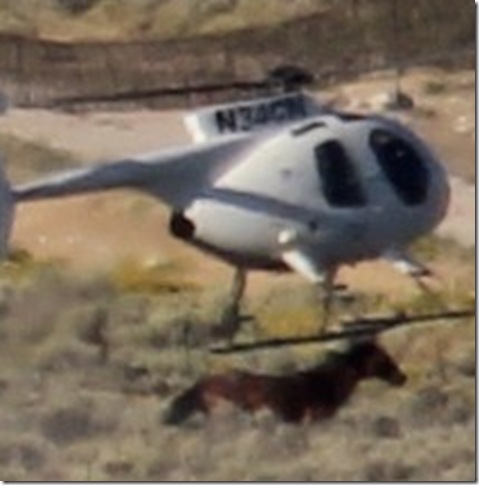

The contractor’s pilot follows his usual pattern which still remains unchecked by the BLM or law enforcement. The pattern consists of breaking apart bands of wild horses and then targeting specific horses. The assault shown here is only a segment that began at 7:12 am when he began to harass a group of 8 wild horses. The wild horses were captured at 7:29 am.

He continuously challenges some of the horses and cuts them apart from the rest. He repeatedly dives down at the horses and flies dangerously close. Often it appears he is losing control of the aircraft as it dips and sways, unsteady in the currents he creates by his actions.

The wild horses change direction to find safety and it appears to me that it angers him and he continues the pattern of abuse even more aggressively.

This seems more to me like he is hunting horses, not herding them.
In the photograph below there is a foal behind the light colored horse underneath the skids

The pattern of chasing the wild horses back and forth, splitting and targeting horses including singling out the foal continues. These stills are only part of the sequence. Another man is in the cockpit with the pilot and I believe it to be John “Jake” Holmes, the owner of Sun J, the helicopter contractor and who is, the pilot Josh Hellyer’s boss. A complaint was filed with the White Pine County Sheriff’s Office.

In this specific sequence this goes on for 25 minutes and is not an isolated instance but has been the documented “norm” throughout the roundup.
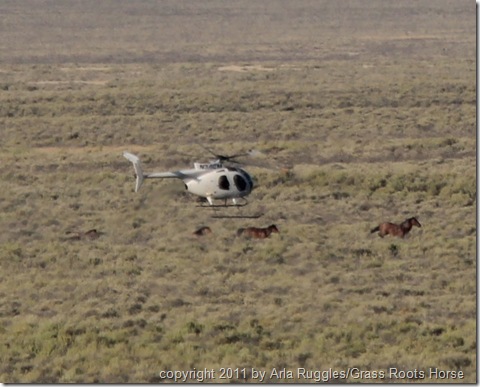
At the trap wings, which is the entrance to the trap, the pilot makes a severely aggressive push to the lead horse which is really what I would call an attack. This is just out of view of observers who are now contained in the horse trailer on the ground level of the hillside.
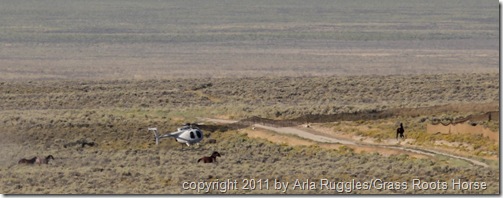
The aggression escalates. My opinion is he knows the public has been contained in a horse trailer surrounded by juniper trees and they have minimal viewing. **At the time the public observers were restricted to the horse trailer, our range photographers documented the pilot was running wild horses up and down the hillside behind them. Photographs were taken from the observation area as well showing the helicopter flying low on the top of the hill and behind it.
The wild horse and burro specialists, Ben Noyes and Ruth Thompson are in constant radio contact with the pilot and ground crew as is the Public Relations person Chris Hanefeld. If they did not know this was happening then they certainly should have known. It is the responsibility of Ben Noyes and Ruth Thompson to ensure the safety and humane treatment of the wild horses at the roundup.

This is a preliminary Part 1 of only 1 round up day. Please don’t wait to contact your congressional representatives. Ask their help today. We will be including other contact information and way that you can take grass roots action !
Please help support this work, whether a donation or volunteer we welcome the help to continue. Donations are tax deductible and we can accept donations of real property as well – cars, trucks, helicopters :)
www.grassrootshorse.com
Photography by Arla M. Ruggles
(Repost from GrassRootsHorse.com )
You can see the jute trap wings crossing the road behind the helicopter in the photo below. It is evident why the horses are dripping in sweat [].
As viewing was so limited at the trap, I do not know if all 5 horses shown in the segments of the highlighted sequence were captured. I think possibly one may have gotten away.


The contractor’s pilot follows his usual pattern which still remains unchecked by the BLM or law enforcement. The pattern consists of breaking apart bands of wild horses and then targeting specific horses. The assault shown here is only a segment that began at 7:12 am when he began to harass a group of 8 wild horses. The wild horses were captured at 7:29 am.

He continuously challenges some of the horses and cuts them apart from the rest. He repeatedly dives down at the horses and flies dangerously close. Often it appears he is losing control of the aircraft as it dips and sways, unsteady in the currents he creates by his actions.

The wild horses change direction to find safety and it appears to me that it angers him and he continues the pattern of abuse even more aggressively.

This seems more to me like he is hunting horses, not herding them.
In the photograph below there is a foal behind the light colored horse underneath the skids

The pattern of chasing the wild horses back and forth, splitting and targeting horses including singling out the foal continues. These stills are only part of the sequence. Another man is in the cockpit with the pilot and I believe it to be John “Jake” Holmes, the owner of Sun J, the helicopter contractor and who is, the pilot Josh Hellyer’s boss. A complaint was filed with the White Pine County Sheriff’s Office.

In this specific sequence this goes on for 25 minutes and is not an isolated instance but has been the documented “norm” throughout the roundup.

At the trap wings, which is the entrance to the trap, the pilot makes a severely aggressive push to the lead horse which is really what I would call an attack. This is just out of view of observers who are now contained in the horse trailer on the ground level of the hillside.

The aggression escalates. My opinion is he knows the public has been contained in a horse trailer surrounded by juniper trees and they have minimal viewing. **At the time the public observers were restricted to the horse trailer, our range photographers documented the pilot was running wild horses up and down the hillside behind them. Photographs were taken from the observation area as well showing the helicopter flying low on the top of the hill and behind it.
The wild horse and burro specialists, Ben Noyes and Ruth Thompson are in constant radio contact with the pilot and ground crew as is the Public Relations person Chris Hanefeld. If they did not know this was happening then they certainly should have known. It is the responsibility of Ben Noyes and Ruth Thompson to ensure the safety and humane treatment of the wild horses at the roundup.

This is a preliminary Part 1 of only 1 round up day. Please don’t wait to contact your congressional representatives. Ask their help today. We will be including other contact information and way that you can take grass roots action !
Please help support this work, whether a donation or volunteer we welcome the help to continue. Donations are tax deductible and we can accept donations of real property as well – cars, trucks, helicopters :)
www.grassrootshorse.com
(2011.AUG.27) GrassRootsHorse report on Triple B Gather (repost)
(2011.AUG.27)
Report by Maureen Lynch Vanderstad
Photography by Arla M. Ruggles
The photograph below shows the seconds before the photo above. You can see the jute trap wings crossing the road behind the helicopter in the photo below. It is evident why the horses are dripping in sweat and notice the small foal to the right in the photo above. As viewing was so limited at the trap, I do not know if all 5 horses shown in the segments of the highlighted sequence were captured. I think possibly one may have gotten away.
The contractor’s pilot follows his usual pattern which still remains unchecked by the BLM or law enforcement. The pattern consists of breaking apart bands of wild horses and then targeting specific horses. The assault shown here is only a segment that began at 7:12 am when he began to harass a group of 8 wild horses. The wild horses were captured at 7:29 am
He continuously challenges some of the horses and cuts them apart from the rest. He repeatedly dives down at the horses and flies dangerously close. Often it appears he is losing control of the aircraft as it dips and sways, unsteady in the currents he creates by his actions.
The wild horses change direction to find safety and it appears to me that it angers him and he continues the pattern of abuse even more aggressively.
This seems more to me like he is hunting horses, not herding them.
In the photograph below there is a foal behind the light colored horse underneath the skids
The pattern of chasing the wild horses back and forth, splitting and targeting horses including singling out the foal continues. These stills are only part of the sequence. Another man is in the cockpit with the pilot and I believe it to be John “Jake” Holmes, the owner of Sun J, the helicopter contractor and who is, the pilot Josh Hellyer’s boss. A complaint was filed with the White Pine County Sheriff’s Office.
In this specific sequence this goes on for 25 minutes and is not an isolated instance but has been the documented “norm” throughout the roundup.
At the trap wings, which is the entrance to the trap, the pilot makes a severely aggressive push to the lead horse which is really what I would call an attack. This is just out of view of observers who are now contained in the horse trailer on the ground level of the hillside.
The aggression escalates. My opinion is he knows the public has been contained in a horse trailer surrounded by juniper trees and they have minimal viewing. **At the time the public observers were restricted to the horse trailer, our range photographers documented the pilot was running wild horses up and down the hillside behind them. Photographs were taken from the observation area as well showing the helicopter flying low on the top of the hill and behind it.
The wild horse and burro specialists, Ben Noyes and Ruth Thompson are in constant radio contact with the pilot and ground crew as is the Public Relations person Chris Hanefeld. If they did not know this was happening then they certainly should have known. It is the responsibility of Ben Noyes and Ruth Thompson to ensure the safety and humane treatment of the wild horses at the roundup.
This is a preliminary Part 1 of only 1 round up day. Please don’t wait to contact your congressional representatives. Ask their help today. We will be including other contact information and way that you can take grass roots action !
Please help support this work, whether a donation or volunteer we welcome the help to continue. Donations are tax deductible and we can accept donations of real property as well – cars, trucks, helicopters :) www.grassrootshorse.com
Report by Maureen Lynch Vanderstad
Photography by Arla M. Ruggles
The photograph below shows the seconds before the photo above. You can see the jute trap wings crossing the road behind the helicopter in the photo below. It is evident why the horses are dripping in sweat and notice the small foal to the right in the photo above. As viewing was so limited at the trap, I do not know if all 5 horses shown in the segments of the highlighted sequence were captured. I think possibly one may have gotten away.
The contractor’s pilot follows his usual pattern which still remains unchecked by the BLM or law enforcement. The pattern consists of breaking apart bands of wild horses and then targeting specific horses. The assault shown here is only a segment that began at 7:12 am when he began to harass a group of 8 wild horses. The wild horses were captured at 7:29 am
He continuously challenges some of the horses and cuts them apart from the rest. He repeatedly dives down at the horses and flies dangerously close. Often it appears he is losing control of the aircraft as it dips and sways, unsteady in the currents he creates by his actions.
The wild horses change direction to find safety and it appears to me that it angers him and he continues the pattern of abuse even more aggressively.
This seems more to me like he is hunting horses, not herding them.
In the photograph below there is a foal behind the light colored horse underneath the skids
The pattern of chasing the wild horses back and forth, splitting and targeting horses including singling out the foal continues. These stills are only part of the sequence. Another man is in the cockpit with the pilot and I believe it to be John “Jake” Holmes, the owner of Sun J, the helicopter contractor and who is, the pilot Josh Hellyer’s boss. A complaint was filed with the White Pine County Sheriff’s Office.
In this specific sequence this goes on for 25 minutes and is not an isolated instance but has been the documented “norm” throughout the roundup.
At the trap wings, which is the entrance to the trap, the pilot makes a severely aggressive push to the lead horse which is really what I would call an attack. This is just out of view of observers who are now contained in the horse trailer on the ground level of the hillside.
The aggression escalates. My opinion is he knows the public has been contained in a horse trailer surrounded by juniper trees and they have minimal viewing. **At the time the public observers were restricted to the horse trailer, our range photographers documented the pilot was running wild horses up and down the hillside behind them. Photographs were taken from the observation area as well showing the helicopter flying low on the top of the hill and behind it.
The wild horse and burro specialists, Ben Noyes and Ruth Thompson are in constant radio contact with the pilot and ground crew as is the Public Relations person Chris Hanefeld. If they did not know this was happening then they certainly should have known. It is the responsibility of Ben Noyes and Ruth Thompson to ensure the safety and humane treatment of the wild horses at the roundup.
This is a preliminary Part 1 of only 1 round up day. Please don’t wait to contact your congressional representatives. Ask their help today. We will be including other contact information and way that you can take grass roots action !
Please help support this work, whether a donation or volunteer we welcome the help to continue. Donations are tax deductible and we can accept donations of real property as well – cars, trucks, helicopters :) www.grassrootshorse.com
Subscribe to:
Posts (Atom)